FE Mechanical exam prep · on the web
Pass the FE. Show your work.
Practice every FE Mechanical topic one subsection at a time, solved with the same Reference Handbook equations you’ll use on exam day. Works in your browser on any phone, tablet or laptop. Nothing to download.
480 problems, more every week3 days freeNo card to startNo surprise chargesStudent launch pricing
Focused content
All 18 chapters, one subsection at a time, each with the exact Handbook search terms.
Practice problems
480 original problems with trap-by-trap solutions, and more every week.
Track progress
Your tower rises a floor for every chapter you master. Eighteen floors and you’re ready.
Build confidence
A readiness check-up and full-length timed practice exams before the real thing.
New to the FE?
The first step to your PE license.
The Fundamentals of Engineering (FE) exam is the first exam on the path to becoming a licensed Professional Engineer. Many engineers hear about it years after graduating. If that’s you, you’re in the right place. You can take it at any point in your career.
110multiple-choice and alternative-item questions
~6 hrstotal appointment at a Pearson VUE test center, with a scheduled break
Year-roundcomputer-based testing, so you pick the date
1 bookThe only reference allowed is the NCEES FE Reference Handbook
Get the FE Reference Handbook (free)
On exam day you get a searchable PDF copy of the NCEES FE Reference Handbook and nothing else. Download your own free copy from NCEES through a MyNCEES account, and practice with it from day one. Every Newton’s Notes problem tells you what to search for in it.
Exam details change from time to time. Always check the current rules, fees and Handbook version on ncees.org.
Exam breakdown
What the FE Mechanical actually covers.
NCEES publishes a range of questions for each of the 14 knowledge areas on the FE Mechanical exam. The bigger the range, the more study time the area deserves. Open any area to see the subtopics it covers.
110questions across 14 knowledge areas
5 h 20 minof exam time inside a 6-hour appointment
Over halfof the exam comes from six areas: statics, dynamics, mechanics of materials, fluids, thermo and design
4–6questions each for ethics, economics and probability, the fastest points on the exam
01Mathematics 6–9 questions5–8% of the exam
- AAnalytic geometry
- BCalculus (differential, integral, single-variable, multivariable)
- COrdinary differential equations (homogeneous, nonhomogeneous, Laplace transforms)
- DLinear algebra (matrix operations, vector analysis)
- ENumerical methods (approximations, precision limits, error propagation, Taylor’s series, Newton’s method)
- FAlgorithm and logic development (flowcharts, pseudocode)
02Probability and Statistics 4–6 questions4–5% of the exam
- AProbability distributions (normal, binomial, empirical, discrete, continuous)
- BMeasures of central tendency and dispersion (mean, mode, standard deviation, confidence intervals)
- CExpected value in decision making
- DRegression, curve fitting and goodness of fit
03Ethics and Professional Practice 4–6 questions4–5% of the exam
- ACodes of ethics and professional conduct
- BPublic health, safety and welfare
- CIntellectual property (copyright, patents, trademarks, trade secrets)
- DSocietal considerations (economic, sustainability, environmental impact)
04Engineering Economics 4–6 questions4–5% of the exam
- ATime value of money (equivalence, present and future worth, annuities, rate of return)
- BCost types and analysis (fixed, variable, incremental, sunk costs)
- CEconomic analyses (cost-benefit, break-even, life-cycle assessment)
05Electricity and Magnetism 5–8 questions5–7% of the exam
- AElectrical fundamentals (charge, current, voltage, resistance, power, magnetic flux)
- BDC circuit analysis (Kirchhoff’s laws, Ohm’s law, series and parallel circuits)
- CAC circuit analysis (resistors, capacitors, inductors)
- DMotors and generators
06Statics 9–14 questions8–13% of the exam
- AResultants of force systems
- BConcurrent force systems
- CEquilibrium of rigid bodies
- DFrames and trusses
- ECentroids and moments of inertia
- FStatic friction
07Dynamics, Kinematics and Vibrations 10–15 questions9–14% of the exam
- AKinematics of particles
- BKinetic friction
- CNewton’s second law for particles
- DWork-energy of particles
- EImpulse-momentum of particles
- FKinematics of rigid bodies
- GKinematics of mechanisms
- HNewton’s second law for rigid bodies
- IWork-energy of rigid bodies
- JImpulse-momentum of rigid bodies
- KFree and forced vibrations
08Mechanics of Materials 9–14 questions8–13% of the exam
- AShear and moment diagrams
- BStress transformations and Mohr’s circle
- CStress and strain from axial loads
- DStress and strain from bending loads
- EStress and strain from torsional loads
- FStress and strain from shear
- GStress and strain from temperature changes
- HCombined loading
- IDeformations
- JColumn buckling
- KStatically indeterminate systems
09Material Properties and Processing 7–11 questions6–10% of the exam
- AProperties (chemical, electrical, mechanical, physical, thermal)
- BStress-strain diagrams
- CFerrous metals
- DNonferrous metals
- EEngineered materials (composites, polymers)
- FManufacturing processes
- GPhase diagrams, transformations and heat treating
- HMaterials selection
- ICorrosion mechanisms and control
- JFailure mechanisms (thermal, fatigue, fracture, creep)
10Fluid Mechanics 10–15 questions9–14% of the exam
- AFluid properties
- BFluid statics
- CEnergy, impulse and momentum
- DInternal flow
- EExternal flow
- FCompressible flow (Mach number, isentropic flow relationships, normal shock)
- GPower and efficiency
- HPerformance curves
- IScaling laws for fans, pumps and compressors
11Thermodynamics 10–15 questions9–14% of the exam
- AProperties of ideal gases and pure substances
- BEnergy transfers
- CLaws of thermodynamics
- DProcesses
- EPerformance of components
- FPower cycles
- GRefrigeration and heat pump cycles
- HNonreacting mixtures of gases
- IPsychrometrics
- JHeating, ventilation and air-conditioning (HVAC) processes
- KCombustion and combustion products
12Heat Transfer 7–11 questions6–10% of the exam
- AConduction
- BConvection
- CRadiation
- DTransient processes
- EHeat exchangers
13Measurements, Instrumentation and Controls 5–8 questions5–7% of the exam
- ASensors and transducers
- BControl systems (feedback, block diagrams)
- CDynamic system response
- DMeasurement uncertainty (error propagation, accuracy, precision, significant figures)
14Mechanical Design and Analysis 10–15 questions9–14% of the exam
- AStress analysis of machine elements
- BFailure theories and analysis
- CDeformation and stiffness
- DSprings
- EPressure vessels and piping
- FBearings
- GPower screws
- HPower transmission
- IJoining methods (welding, adhesives, fasteners)
- JManufacturability (limits, fits)
- KQuality and reliability
- LComponents (hydraulic, pneumatic, electromechanical)
- MEngineering drawing interpretation and GD&T
Practice in the same proportions
The FE Mechanical Practice Problems book follows these weights. Each 55-question set carries every area in proportion, and every two sets make a full 110-question exam with each area inside its official range.
Source: NCEES FE Mechanical CBT exam specifications, effective July 2020. Percentages are of the 110 questions, rounded. Exam specifications change from time to time; always confirm the current version at ncees.org.
How it works
Study the way the exam is built.
1
One subsection at a time
Short sets on one idea, with earlier topics mixed back in so nothing fades.
2
Find it in the Handbook
Each topic lists exactly what to search for, so finding equations becomes automatic.
3
Learn why you missed it
Every wrong answer names its trap: units, the wrong equation, a calculator slip.
4
Raise the tower
Each subject you master adds a floor. Eighteen floors and you’re ready.
Try one · Handbook: Law of Cosines
A triangle has sides of 7 and 10 with a 60° angle between them. The third side is closest to:
Pricing
Start free. Pay only for the time you need.
Every plan starts with a 3-day free trial, no card needed. When you’re ready, buy 1, 2 or 3 months of access. Passes don’t auto-renew, so you’re never charged by surprise.
Launch offer: student pricing runs for the first 30 days after launch. Verify a school email (.edu, .ac.uk and similar) once with a 6-digit code, and the student price applies to any pass you buy while the offer is on. Sample prices for this preview.
Compare plans
What’s in each plan.
| Feature | Free trial | Basic | Pro | Bundle |
|---|
The books
Prefer paper? Two books, two jobs.
Learn each topic with the Review Guide, then test yourself with the Practice Problems book, mixed and weighted like the real exam. Every problem in both books is new: none repeats the online course or the other book.
Coming soon
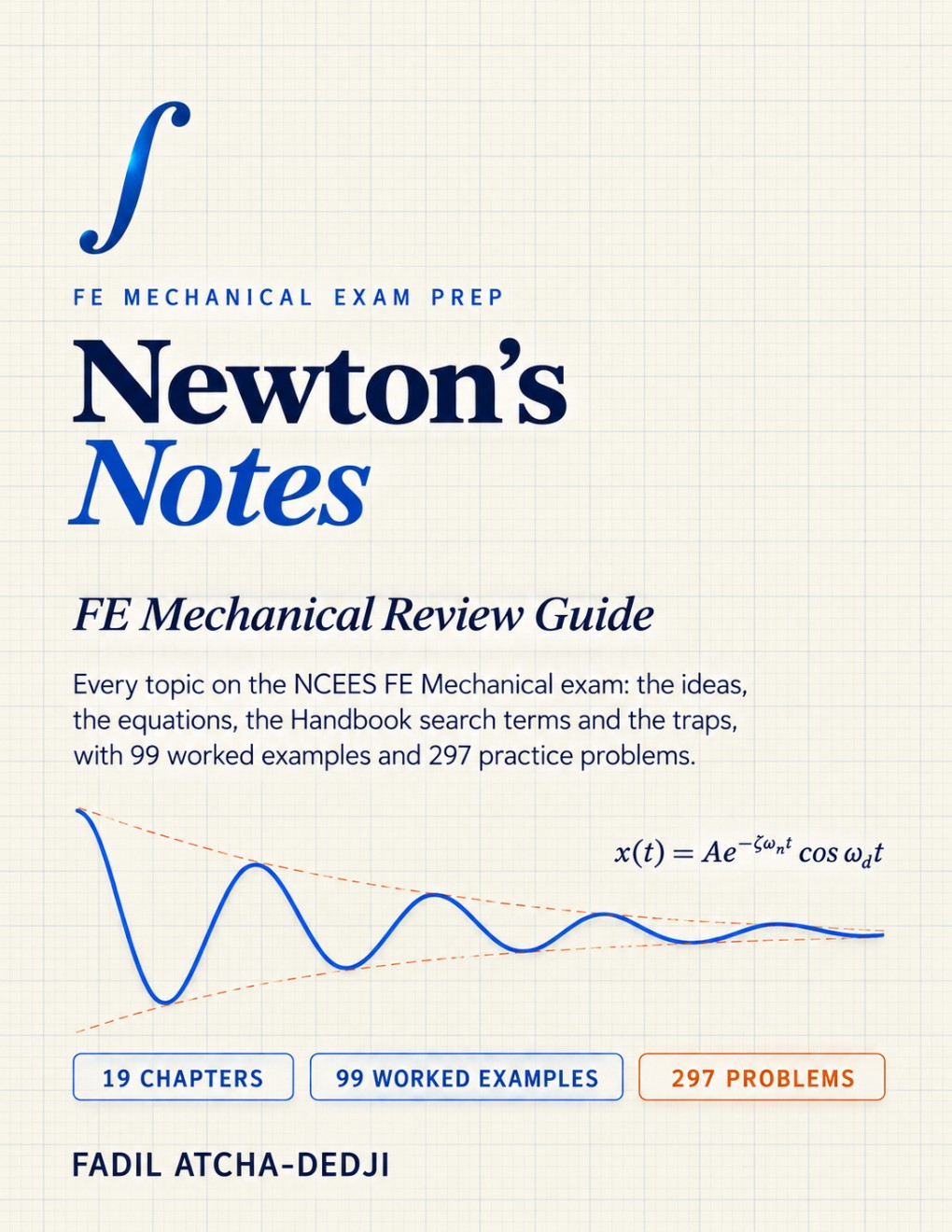
Learn it · chapter by chapterFE Mechanical Review Guide
Nineteen chapters that follow the course and cover every NCEES subtopic. Each section gives the key ideas, the equations, the Handbook search terms and the traps, then a worked example and three practice problems.
- 220 pages, 8.5 × 11 in.
- 99 worked examples and 297 practice problems
- Chapter checklists and full solutions
- Handbook search-term index and NCEES topic map
$40 PDF$50 PaperbackPDF included in the Bundle
Coming soon
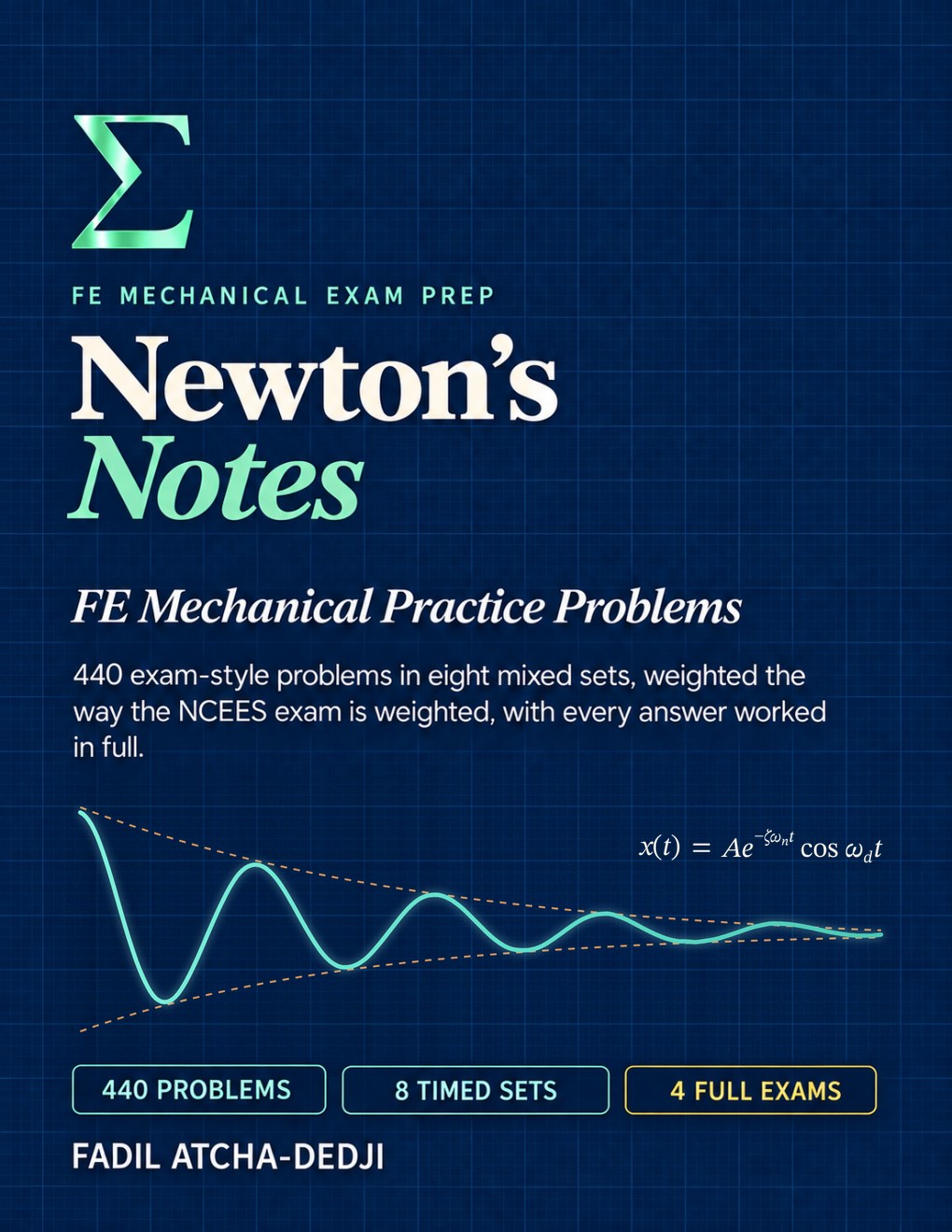
Test it · mixed like the examFE Mechanical Practice Problems
Eight mixed 55-question sets, each weighted like the real exam, so you learn to recognize a topic before you solve it. Every two sets make a full 110-question practice exam.
- 124 pages, 8.5 × 11 in.
- 440 problems, every answer worked in full
- Answer sheets and score-by-area tables
- Topic index by NCEES area
$30 PDF$40 PaperbackSold separately
Both books are coming soon in paperback and as PDFs, at the launch prices shown. The Review Guide PDF is included in the Bundle; the Practice Problems book is sold separately.
Questions
Good to know.
Do I need to download an app?
No. Newton’s Notes runs in your web browser on phone, tablet or computer. You can add it to your home screen if you like, but there’s nothing to install and no in-app purchases.
What happens when my free trial ends?
Nothing, unless you choose a plan. We don’t ask for a card to start, so we can’t charge you by surprise. Your progress is saved if you come back.
Do plans renew automatically?
No. You buy 1, 2 or 3 months of access. When it ends, you can add more time or simply stop.
What’s the difference between Basic and Pro?
Both unlock every subject and problem. Pro adds Ask Newton, the AI tutor that re-explains any problem a different way, the custom test builder (pick the chapters and sections you want and get a fresh test every time), calculator keystrokes and full-length timed practice exams.
Is this official NCEES material?
No. Every problem is original. Solutions point you to the free NCEES FE Reference Handbook so you practice with the equations you’ll have on exam day.
Is there a student discount?
Student pricing runs as a limited-time promotion, starting with the first 30 days after launch. While it’s on, turn on “I’m a student” under Pricing and verify your school-issued email (.edu, .ac.uk and similar) with a 6-digit code. The student price applies to any pass you buy while the offer is running.
Can I share my account or screenshots with a friend?
No. Each account is for one person. Course pages carry a watermark with your email and a session code, and sharing problems or screenshots ends access. Your friend can start their own free trial.
How often are new problems added?
Every week. The bank holds 480 problems across all 18 chapters plus a full-length practice exam, and new problems are added every week.
Civil or Electrical?
Mechanical comes first. Civil and Electrical are planned next.
Terms of use
Fair use keeps the price fair.
Newton’s Notes is written by one engineer and priced for students. These rules protect that. Here’s the short version; the full Terms of Service apply.
One person, one accountNo shared logins, resold access or group accounts.
No copying or postingDon’t screenshot, record, download, post or upload problems or solutions anywhere, or use them to train AI.
Watermarked and loggedCourse pages show your email and a session code, and we log what each account opens, so leaks can be traced.
Copies get taken downWe file DMCA takedown notices against sites that post our content, and end the accounts it came from.
Found Newton’s Notes content posted somewhere it shouldn’t be, or want to report a copyright concern? Email n3wtonsnotes@gmail.com. Full Terms of Service: [link at launch].